The deep blue of the Jurassic period has recently yielded a secret that has been buried for 180 million years.
From the mud of the United Kingdom to the clay pits of Germany, paleontologists have unearthed the remains of the Ichthyosaur—a creature so formidable it has earned the nickname “The Sea Dragon.” This isn’t just another fossil; it is a time capsule of resilience, biology, and prehistoric drama.
The Rutland Sea Dragon: A British Behemoth
In 2021, a routine lagoon draining at the Rutland Water Nature Reserve in England revealed something “unprecedented.” What first looked like clay pipes sticking out of the mud turned out to be the vertebrae of a 33-foot-long (10-meter) titan.
- Massive Scale: The skull alone weighs roughly two tonnes.
- A UK First: Identified as Temnodontosaurus trigonodon, this was the first time this specific giant species was confirmed in the UK, having previously only been known in Germany.
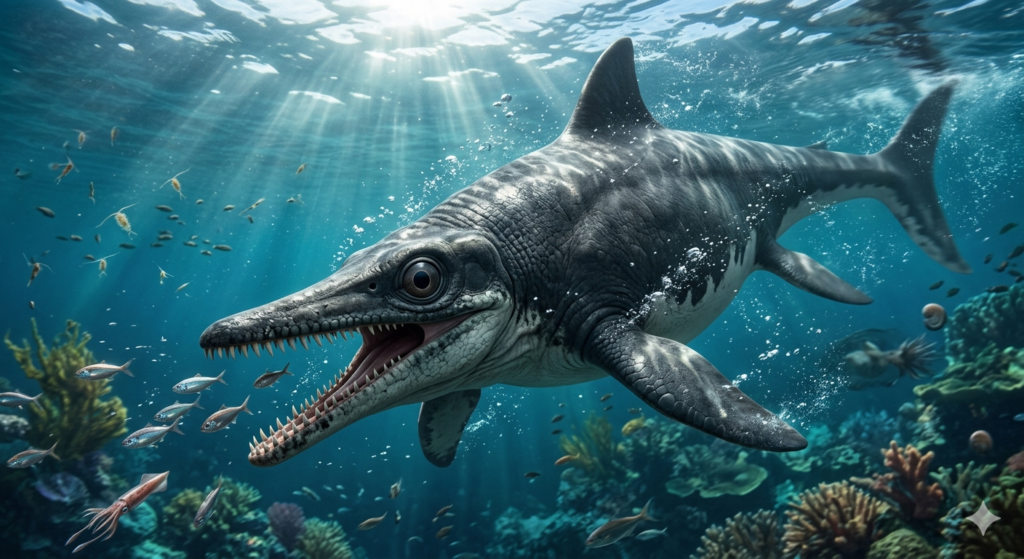
- The “Dragon” Anatomy: With a sleek, dolphin-like body and eyes the size of footballs, it was designed to hunt in the pitch-black depths of the ancient ocean.
Survival Against the Odds: The German Discovery
While the Rutland find was about size, a recent 2026 discovery in Mistelgau, Germany, tells a story of survival. Researchers found a 180-million-year-old Temnodontosaurus that had survived severe injuries to its jaw and shoulder.
The “Stomach Stone” Mystery
In a rare find for this species, scientists discovered gastroliths (stomach stones) inside the creature’s belly.
- Why stones? Because its injuries made it difficult to hunt fast prey, experts believe it may have swallowed stones to help grind up easier-to-catch, shelled food—much like a modern bird.
- Resilience: The heavily worn teeth suggest that despite its “broken” body, this sea dragon lived for years, adapting its diet to survive in a cutthroat ecosystem.
Reptile or Dolphin? The Biological Marvel
Though it looks like a dolphin, the Ichthyosaur was a marine reptile. However, 180-million-year-old specimens have revealed something shocking: soft tissue preservation.
- Warm-Blooded: Analysis of skin and blubber remnants suggests these creatures were warm-blooded, allowing them to migrate across vast, cold oceans.
- Camouflage: Evidence of “countershading” (dark on top, light on bottom) shows they used the same camouflage as modern sharks and whales to ambush prey and hide from larger predators.
- Live Birth: Unlike most reptiles that lay eggs, the Ichthyosaur gave birth to live young in the water—a specialized evolutionary leap.
Why It Matters Today
These discoveries are rewriting the timeline of the Jurassic era. They show us that the “Sea Dragons” weren’t just temporary residents of the ocean; they were highly adaptable masters of the deep that dominated for over 160 million years.
Every tooth and vertebrae pulled from the mud today helps us understand how life adapts to extreme physical trauma and changing environments—lessons that remain relevant even 180 million years later.